

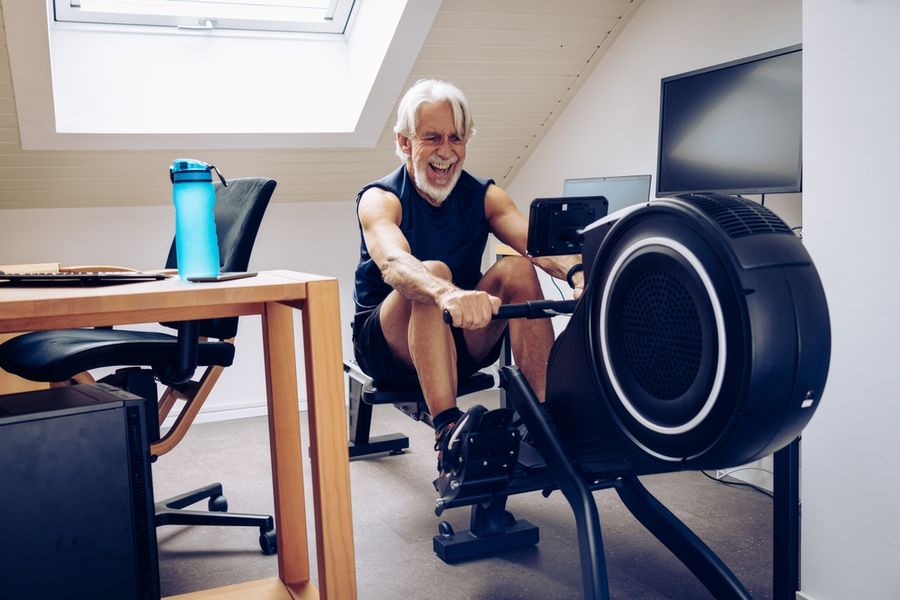
Rowing machines and ellipticals are both popular cardio options for people who want a challenging workout without the pounding impact of running. They can raise your heart rate, fit into a home gym, and support steady endurance training. A rowing machine asks the legs, core, back, and arms to coordinate in one repeated stroke, while an elliptical emphasizes a smoother standing stride with optional upper-body involvement. Understanding the distinct ways they use the body is essential.
Why This Comparison Matters
Choosing between a rowing machine and an elliptical is not only about calories, sweat, or how hard the workout feels. The better question is which movement pattern fits the kind of training you want. Rowing is a seated pull-and-drive motion that depends on timing, posture, and full-body coordination. An elliptical is a standing, gliding motion that simulates walking, running, or stair climbing, especially when resistance and incline are adjusted.
Both machines are commonly treated as low-impact cardio choices because they reduce the repetitive pounding associated with running. That can make either option appealing for people who want aerobic training while being mindful of joint comfort. The muscle-group question, however, is where the comparison becomes more specific. Rowing tends to demand more deliberate pulling, bracing, and posterior-chain involvement, while an elliptical can involve the upper and lower body when the moving handles are used actively.
Which Muscle Groups Are You Focusing On?
|
Muscle Group |
Rowing Machine |
Elliptical |
Which Works It More Directly? |
|---|---|---|---|
|
Quadriceps |
Strongly used during the leg drive |
Used during the forward stride and resistance work |
Rowing machine |
|
Hamstrings |
Used during leg drive and recovery control |
Used during stride motion, especially with resistance |
Tie, depending on setup |
|
Glutes |
Involved in the drive phase |
Used during stride, especially with incline or resistance |
Tie, with rowing often feeling more deliberate |
|
Calves |
Support foot pressure and recovery |
Used continuously during the gliding stride |
Elliptical |
|
Core |
Needed for posture, bracing, and force transfer |
Used for balance and upright control |
Rowing machine |
|
Upper Back |
Used heavily during the pull |
Used lightly to moderately with moving handles |
Rowing machine |
|
Lats |
Used during the pulling phase |
Limited unless handles are used with intent |
Rowing machine |
|
Biceps |
Assist the handle pull near the finish |
Assist pulling the moving handles |
Rowing machine |
|
Triceps |
Less prominent, mostly during recovery control |
Assist pushing the moving handles |
Elliptical |
|
Chest |
Minimal direct role |
Can assist when pushing handles |
Elliptical |
|
Shoulders |
Assist rowing posture and handle control |
Used with moving handles |
Tie, depending on form |
How A Rowing Machine Uses The Body
A rowing stroke has several phases: catch, drive, finish, and recovery. At the catch, the knees are bent, the shins are near vertical, and the arms reach forward. During the drive, the legs push first, the torso swings open, and the arms pull last. At the finish, the handle comes toward the body while the core stays braced. The recovery reverses the motion with control.
This sequence is why rowing is usually the stronger full-body answer in a muscle-group comparison. The legs begin the work, the core helps transfer force, and the back and arms finish the pull. It is not a substitute for dedicated strength training, but it does combine aerobic effort with repeated muscular coordination. For people who want cardio that also feels like strength endurance, rowing has a clear advantage.
How An Elliptical Uses The Body
An elliptical uses a different pattern. The feet stay on pedals while the legs move through a smooth, continuous stride. The motion can resemble walking, running, or stair climbing, depending on the machine design and the settings used. The lower body does most of the work if the user simply glides along, but the core still helps maintain posture and balance.
The upper-body role depends on the handles. Ellipticals with moving handles can engage both the upper and lower body, especially when the user pushes and pulls with purpose rather than lightly holding on. That makes the machine more versatile than it may first appear. However, the upper-body work is optional in a way that rowing’s pulling phase is not.
Which Machine Works More Muscle Groups?
If the question is which machine works more muscle groups by design, the rowing machine usually has the edge. Its basic motion requires the legs, hips, core, back, shoulders, and arms to participate in sequence. Poor form can reduce the benefit or shift the effort unevenly, but the exercise itself is built around coordinated full-body movement.
The elliptical can also involve many muscle groups, but the machine allows more variation in how much the upper body contributes. Someone who actively uses the handles, keeps posture tall, increases resistance, and adjusts incline can create a more complete workout. Someone who holds the stationary rails and glides casually may mainly train the legs and cardiovascular system. For automatic full-body involvement, rowing wins. For adjustable, standing, low-impact cardio with optional upper-body work, the elliptical remains a strong choice.
The Lower-Body Difference
Rowing and elliptical training both use the lower body, but they use it differently. Rowing emphasizes a powerful leg drive from a seated position. The quadriceps help extend the knees, while the glutes and hamstrings support hip extension and control. Because the feet are fixed and the motion is horizontal, rowing can feel like repeatedly pushing away from the machine before finishing the stroke with the torso and arms.
The elliptical is more continuous. The legs cycle through a gliding stride with the feet staying on the pedals. The calves tend to stay involved because the feet remain loaded through the moving path. Resistance can make the legs work harder, while incline may change how much the glutes and hamstrings are emphasized. If the resistance is low, the workout may feel smoother but less muscularly demanding.
The Upper-Body Difference
Upper-body work is where the rower separates itself most clearly. Each proper stroke includes a pulling phase that uses the upper back, lats, rear shoulders, and biceps. The arms should not start the stroke, but they do finish it. This makes rowing useful for people who want cardio that includes repeated pulling mechanics, especially if they spend much of the day sitting and reaching forward.
On an elliptical, the upper body depends on handle use. Moving handles can involve the shoulders, chest, triceps, biceps, and back, but the effort is usually less direct than a rowing pull. The elliptical may be better for someone who wants light upper-body participation without learning a technical stroke. The rower is better for someone who wants back-and-arm involvement built into the cardio session.
Technique And Learning Curve
The elliptical is usually easier to start. Step onto the pedals, hold the handles, set resistance, and move. There is still room for better or worse form, but the basic motion is intuitive for most people. That makes it approachable for beginners, shared households, and people who want low-friction cardio without much instruction.
Rowing has a steeper learning curve. Beginners often pull too early with the arms, round the back, rush the recovery, or slide too quickly into the next stroke. Those habits can make the movement feel awkward and reduce the training benefit. Short form-focused sessions can help the stroke become more natural. Once the rhythm improves, rowing can feel smooth, powerful, and efficient, but it asks for more attention at the beginning.
Which One Should You Choose?
Choose a rowing machine if you want a more integrated full-body workout, especially one that emphasizes the legs, core, back, and pulling muscles. It can be a strong choice for people who enjoy measurable effort, interval training, and technique-based movement. It is also useful if you want cardio that feels less like simply moving your feet and more like coordinated power.
Choose an elliptical if you want a simple, standing, low-impact cardio option that is easy to use while watching a show, warming up, or doing steady endurance work. It may also be better if you prefer a smoother, less technical movement. For more muscle involvement, use the moving handles actively, increase resistance gradually, and adjust incline if your machine offers it.
The Stronger Full-Body Choice
Rowing machines generally work more muscle groups more directly because the stroke requires coordinated effort from the legs, core, back, and arms. Ellipticals can become full-body machines, especially with moving handles and enough resistance, but they do not force the upper body to contribute in the same way. That makes rowing the stronger answer for people asking which option engages more of the body.
The better machine, however, is not always the one that works the most muscles. It is the one you will use consistently, safely, and with enough intensity to support your goals. A rower may be ideal for full-body training, while an elliptical may be easier for daily, low-impact cardio. Both can belong in a smart fitness routine; the right choice depends on your body, your space, and the kind of movement you will actually repeat.
We created this article in conjunction with AI technology, then made sure it was fact-checked and edited by an TheInsiderScoop editor.